Many independent pharmacy owners assume that only large repayment demands or allegations of fraud can lead to a Pharmacy Benefit Manager (PBM) network termination. Unfortunately, that assumption is often incorrect.
In reality, PBMs frequently rely on contractual provisions that allow them to suspend or terminate pharmacies based on alleged violations of their provider agreements, regardless of the dollar amount identified during an audit. A seemingly minor documentation error or clerical mistake can sometimes result in consequences that far exceed the value of the audit finding itself.
For an independent pharmacy, the loss of access to a major PBM network can affect cash flow, patient relationships, and long-term business viability. Understanding how PBM audits work and knowing how to respond can make a significant difference.
Below are answers to some of the most common questions pharmacy owners ask after receiving a PBM audit notice, repayment demand, suspension notice, or network termination letter.
While every PBM provider agreement is different, understanding the audit process and your contractual rights can help you respond strategically and reduce the risk of unnecessary business disruption.
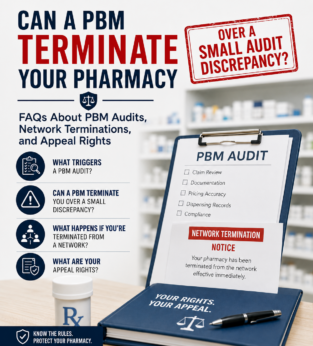
Can a PBM terminate my pharmacy over a small audit discrepancy?
Yes.
One of the most common misconceptions is that only substantial overpayments or evidence of intentional misconduct lead to network termination. In practice, the amount identified during an audit is only one factor and often not the most important one.
Many PBM provider agreements give the PBM broad authority to terminate or suspend participating pharmacies for alleged violations of contractual obligations or program requirements. As a result, even relatively small repayment demands may be accompanied by allegations of noncompliance that place the pharmacy’s network participation at risk. In our experience, PBMs have terminated pharmacies over a few thousand dollars in discrepancies based on the types of discrepancies, and not necessarily based on the dollar amount itself or how much business the pharmacy may otherwise do with the PBM.
For many pharmacies, losing access to a PBM network is far more financially damaging than the overpayment amount itself.
Why would a PBM terminate a pharmacy over a relatively minor issue?
PBM audits are designed to evaluate more than billing accuracy.
PBMs often use audits to assess whether a pharmacy has complied with the terms of its provider agreement, internal policies, and applicable regulatory requirements. While an audit may begin with a review of a handful of prescriptions, the PBM may evaluate broader issues such as documentation practices, recordkeeping, billing procedures, and operational compliance.
Repeated documentation deficiencies, incomplete records, or procedural errors may be viewed by a PBM as evidence of broader compliance concerns, even when the associated repayment amount is relatively small.
This goes beyond the underlying incentive to create more narrow networks of pharmacies, and to often route patients to the PBM’s wholly owned pharmacies instead.
What types of audit findings commonly create issues?
Not every audit involves allegations of fraud or intentional misconduct. In many cases, pharmacies receive adverse findings based on documentation or administrative issues, including:
- Missing or incomplete prescription records
- Inventory or purchasing discrepancies
- Inadequate proof of delivery documentation
- Recordkeeping deficiencies
- Incorrect days’ supply calculations
- Billing inconsistencies
- Incomplete proof of copayment or failure to collect copayments
- Prior authorization submissions
- Violations of PBM policy requirements
While any one issue may appear insignificant, multiple findings can increase a pharmacy’s exposure during an audit.
Are clerical errors treated the same as fraud?
Not necessarily.
There is an important distinction between intentional fraudulent conduct and documentation or administrative errors. However, pharmacies should not assume that an audit involving clerical issues carries little risk. This is particularly true where PBMs often treat clerical issues as indicia or fraud, waste, and abuse in the course of an investigation or an investigative audit.
Depending on the provider agreement and the circumstances of the audit, documentation deficiencies alone may lead to overpayments, corrective action plans, suspension, or network termination.
Every audit finding deserves careful evaluation before conclusions are accepted or repayment is made.
Does paying the audit automatically resolve the matter?
No.
Many pharmacy owners assume that once they repay the amount identified during an audit, the matter is closed. Unfortunately, that is not always the case.
Depending on the PBM’s findings, repayment may resolve only the financial component of the audit. The PBM may still evaluate whether the alleged conduct warrants additional contractual remedies, including probation, suspension, or termination from the network.
For that reason, pharmacies should view every audit as more than simply a repayment dispute.
Can a PBM suspend my pharmacy before terminating it?
In many cases, yes.
Some PBMs may temporarily suspend a pharmacy’s participation while investigating audit findings or alleged contractual violations. During a suspension, pharmacies may experience payment delays, claim processing issues, or other operational disruptions.
Because every provider agreement is different, pharmacies should carefully review the applicable contract and any notices received from the PBM to understand the potential consequences and available response options.
Do state laws protect pharmacies from PBM audit abuses?
Possibly.
Many states have enacted laws governing PBM audits, appeal procedures, recoupments, and other aspects of the PBM-pharmacy relationship. Depending on the jurisdiction, these laws may establish procedural protections relating to notice requirements, audit timing, documentation requests, appeal rights, or limitations on certain audit practices.
However, these protections vary significantly from state to state, and they may not apply equally in every situation. A pharmacy’s rights often depend on both the governing provider agreement and applicable state and federal law. In addition, PBMs often initiate “investigations” and broadly allege fraud, waste, and abuse as a means of circumventing state laws, particularly fair audit laws that would otherwise apply to a regular audit.
What should my pharmacy do immediately after receiving a PBM audit notice?
The actions taken during the early stages of an audit can significantly affect the outcome.
Pharmacies should consider taking the following steps:
- Review the audit notice carefully. Identify the scope of the audit, applicable deadlines, and requested documentation.
- Preserve all records. Gather complete prescription records, dispensing documentation, proof of delivery records, communications, invoices, and other relevant materials.
- Review the provider agreement and manual. The contract often governs audit procedures, appeal rights, and the PBM’s available remedies.
- Calendar every deadline. Missing a response deadline may limit your ability to challenge adverse findings.
- Evaluate the findings before responding. Do not assume that the PBM’s conclusions are necessarily accurate or complete.
- Seek experienced guidance when appropriate. Early legal review may help identify contractual defenses, documentation issues, or procedural concerns before the matter escalates.
What mistakes should pharmacies avoid during a PBM audit?
Several common mistakes can make an audit more difficult to defend.
These include:
- Ignoring audit correspondence
- Missing response or appeal deadlines
- Providing incomplete documentation
- Assuming a small repayment amount means the issue is insignificant
- Failing to preserve relevant records
- Accepting audit findings without careful review
- Waiting until after receiving a termination notice to seek legal guidance
Responding strategically from the outset often provides more options than attempting to reverse an adverse decision later.
Can pharmacies challenge PBM audit findings or network terminations?
Yes.
Many PBM provider agreements include procedures for appealing repayment demands, suspension decisions, or network terminations. These procedures frequently contain strict deadlines and documentation requirements. An appeal may provide an opportunity to submit additional documentation, correct factual misunderstandings, or challenge the PBM’s interpretation of contractual requirements. Because appeal procedures differ among PBMs, pharmacies should carefully review the applicable provider agreement and act promptly.
In addition to the appeal rights identified in a PBM provider agreement or manual, there are also other contractual and legal remedies pharmacies can explore.
Can a pharmacy be reinstated after a PBM network termination?
It depends.
Whether a pharmacy can be reinstated depends on the terms of the provider agreement, the reason for the termination, the applicable appeal procedures, and the facts of the particular case.
Many PBM agreements provide some form of appeal or reconsideration process that allows pharmacies to challenge audit findings or termination decisions. In some situations, additional documentation or clarification may resolve factual disputes or demonstrate that the PBM’s conclusions were based on incomplete or inaccurate information.
Depending on the circumstances, a pharmacy may also have opportunities to negotiate a resolution, implement corrective action measures, or pursue other contractual or legal remedies. In more complex disputes, litigation or arbitration may become appropriate if a pharmacy believes the PBM failed to comply with the provider agreement or applicable law.
Because provider agreements often contain strict deadlines and detailed procedural requirements, pharmacies should act promptly after receiving a suspension or termination notice. Early review of the provider agreement and available response options may help preserve important rights and improve the likelihood of a favorable outcome.
What happens if my pharmacy is terminated from a PBM network?
A PBM network termination can have immediate and far-reaching consequences that extend well beyond the audit itself.
Depending on the PBM and the terms of the provider agreement, a terminated pharmacy may no longer be able to process claims for patients covered under that PBM’s plans. This can lead to lost revenue, significant cash flow challenges, and difficult conversations with patients who may need to transfer their prescriptions elsewhere.
A network termination can also disrupt relationships with prescribers, referral sources, and patients who have come to rely on your pharmacy’s services. Operationally, pharmacies may need to dedicate substantial time and resources to responding to patient inquiries, addressing claim denials, and managing the administrative burden associated with the termination.
In some cases, a termination by one PBM may also raise questions during future credentialing or contracting with other PBMs or payors. While every situation is different, pharmacies should understand that the effects of a network termination may extend well beyond the immediate loss of reimbursement.
Because the business and operational consequences can be significant, pharmacies should carefully evaluate their response options as soon as they receive a suspension or termination notice.
Can one PBM audit lead to additional investigations?
It can.
Although every situation is different, significant audit findings may lead to additional scrutiny from other PBMs, payors, or regulatory agencies, including Boards of Pharmacy, depending on the nature of the issues involved.
Addressing audit concerns promptly and implementing corrective measures may help reduce future compliance risks.
Are PBM audits becoming more sophisticated?
Yes.
PBMs increasingly use predictive analytics, billing algorithms, prescription utilization data, refill patterns, reimbursement trends, and other data-driven tools to identify pharmacies for audit and investigate potential contractual or billing irregularities.
Rather than selecting pharmacies randomly, many audits are now driven by data that flags prescribing, dispensing, or billing patterns the PBM considers unusual or suggestive of outlier practices. This allows PBMs to focus audit resources on pharmacies they perceive as presenting a higher level of risk.
As audit methods continue to evolve, maintaining strong compliance programs, thorough documentation, and regular internal reviews is more important than ever.
How can pharmacies reduce their risk during future PBM audits?
While no pharmacy can eliminate the possibility of an audit, several proactive measures can reduce risk:
- Conduct periodic internal compliance reviews.
- Perform mock PBM audits.
- Maintain complete and organized prescription documentation.
- Train staff regularly on PBM-specific requirements.
- Monitor recurring documentation issues.
- Update compliance policies as PBM requirements change.
- Address deficiencies promptly before they become larger problems.
Strong compliance practices not only improve audit readiness but also help demonstrate a pharmacy’s commitment to meeting contractual and regulatory obligations. Frier Levitt regularly publishes an audit checklist that pharmacies should take advantage of to prepare for any PBM audit. Click here for access.
Key Takeaways About PBM Audits and Network Terminations
PBM audits should never be evaluated solely by the size of the alleged overpayment.
Even relatively small audit discrepancies can expose a pharmacy to repayment demands, suspension, or network termination, depending on the provider agreement and the nature of the alleged violations. Understanding your contractual obligations, maintaining thorough documentation, and responding strategically to audit findings can significantly reduce your risk.
If your pharmacy receives a PBM audit notice, repayment demand, suspension notice, or network termination letter, acting quickly is critical. Early evaluation of the audit findings, the governing provider agreement, and your available appeal rights may help preserve your network participation and protect your business before the situation escalates.
How Frier Levitt Can Help
PBM audits often involve far more than a repayment demand. Depending on the circumstances, they can evolve into disputes over network participation, reimbursement, credentialing, state Board of Pharmacy investigations, or even litigation. The earlier a pharmacy understands its contractual rights and response options, the better positioned it may be to protect its business.
Frier Levitt’s Pharmacy Practice Group represents independent, specialty, compounding, long-term care, home infusion, and other pharmacies nationwide in matters involving PBM audits, network terminations, reimbursement disputes, credentialing issues, and regulatory enforcement. Our attorneys routinely advise pharmacies at every stage of the audit process—from responding to audit notices and challenging repayment demands to pursuing administrative appeals and litigating disputes when necessary.
Because our team works with pharmacies every day, we understand the operational and financial impact that a PBM audit or network termination can have on a business. We take a practical, strategic approach to helping clients protect their network participation, preserve revenue, and minimize disruption to patient care.
If your pharmacy receives a PBM audit notice, suspension, repayment demand, or network termination letter, seeking experienced legal counsel early in the process may help identify available defenses, preserve important appeal rights, and improve your ability to achieve a favorable outcome.